Or, rather, Wats we saw.
Wat Pra That Nong Bua. The main structure is a huge, square stupa with another 4-story square gilded (or gold painted) stupa inside.
Has a quiet environment due to the many surrounding trees.
A monk was available to bless the visitors by sprinkling with water.
Also, religious medals and wrist bands can be bought.
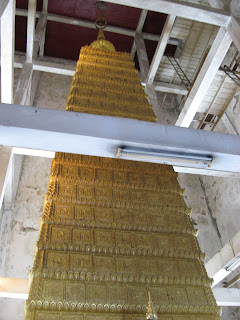 This "golden stupa" is inside the main, silver-colored stupa at Wat Nong Bua.
 Wat Ban Na Nuang. Pass beneath an immense 3-headed elephant and park on the left in the shade. To the left and forward is a replica of a Thai royal “dragon” barge or boat, complete with a rowing crew, upon which is a temple. The boat is colored or painted to resemble dark wood, and there is a low concrete wall around the boat. The multi-headed dragons atop the wall are very prominent. The gate to “barge wat” was closed when we visited, but there was a Hindu-style multi-headed god on the far side (the bow of the boat) where we could light incense and pay respects.
To the right is a large building—on the second floor are many more Buddha statues. The main (the largest) Buddha statue is on a slightly elevated platform that specifically says “no women.” To the left and front of this Buddha statue is a glass-encased wax mannequin of a monk. To the left and rear of this platform is an alcove-type area that has 3 large monk portraits (women are also prohibited here), and—slightly to the right/rear—an elevated glass-cased coffin that holds the mummified body of one of the monks or holy persons who worked on this Wat. This may be the same person represented by the wax statue on the main platform (not sure). To the right of the main platform are 10 statues…5 of Buddha and 5 smaller statues of monks or holy men.
The wat also has a 3 tiered drum or bell tower—very elaborate. There are drums on the lower level, and a bell on the highest level.
The largest structure on the grounds is a masonry replica of another dragon barge set into a large fish pond. There is another temple set onto the barge, with another huge Buddha statue inside. This temple has a lot of decoration, painted gold and blue. Also, much applied mirror mini-tile is set onto various surfaces. There are two walkways to the boat—on the land side, food is sold to feed the fish. Some of the fish are quite large, and even catfish will come to the surface to feed.
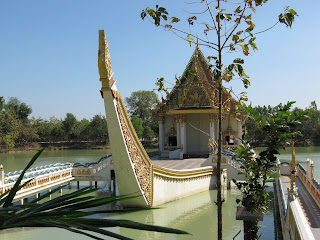
This temple at Wat Ban Na Nuang sits on a replica barge, surrounded by a genuine fish pond.
There is significant construction on-going on the grounds. A new building awaits finishing, and another building site is being prepared.
Wat Pra Nanachat. A beautiful, very serene area—the name roughly translates to “jungle or forest” and “many cultures.” It is heavily forested compared to the surrounding countryside. Much of the signage is in both English and Thai. The public areas seem to be for meditation and contemplation. There is a large open-sided building (a sign on the building mentions a website, watpahnanachat.org), but not much to see inside.
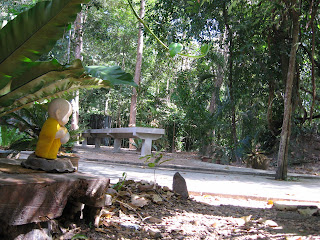
Sitting on a meditation bench, looking toward the granite table, at Wat Pra Nanachat.
There is also a pyramid-shaped metal structure (which I didn’t enter), but--again--there is not much to “see,” as such. A long stone table of polished granite sits in the open—it’s 15 paces long. Strangely, in the restroom area, there are icons and signs which say “remove your shoes before entering the toilets.” The toilets (Asian style) were very clean. Pictures are discouraged (as are cell phones and camcorders), but we took some photos discretely.
Wat Nong Pa Phong. The main structure is modern Asian with 3 levels—it could almost be a government administration building. On the main floor is an altar with an elevated casket—it holds (or once held) the body of a well-known monk. There are also strangely incongruous objects on display in other rooms—a traditional wooden cart, deer antlers, an elephant skull, and wasps nests, along with wooden chests and wheel chairs. While all the signs are in Thai, these items may have belonged to or were gifts to the monks.
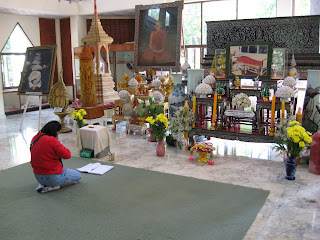
Newt prays at the altar on the first floor of the building at Wat Nong Pa Phong.
Several wooden cabinets on the different floors have foreign currency on display—there are also wooden carved panels, and a near-lifesized wooden carved Buddha.
From a central stairway, a multi-story, multi-framed tiled mural depicts the activities of monks—one particular monk wearing distinctive glasses is shown several times. On the second floor is a large, dark bronze standing Buddha, and on the third floor is a wax model of a monk-with-glasses behind a glass wall—he’s seated on rattan settee next to his eyeglass case, with a teapot on his left. It looks to be a life-sized vignette, with him frozen in time.
To see more pictures, please visit http://picasaweb.google.com/NewtSea
 Marinated Shrimp appetizer.
 Butterflied crispy-fried fish.
 "Cotton" fish ("cotton" refers to its preparation).
 Chicken soup, with coconut milk.


